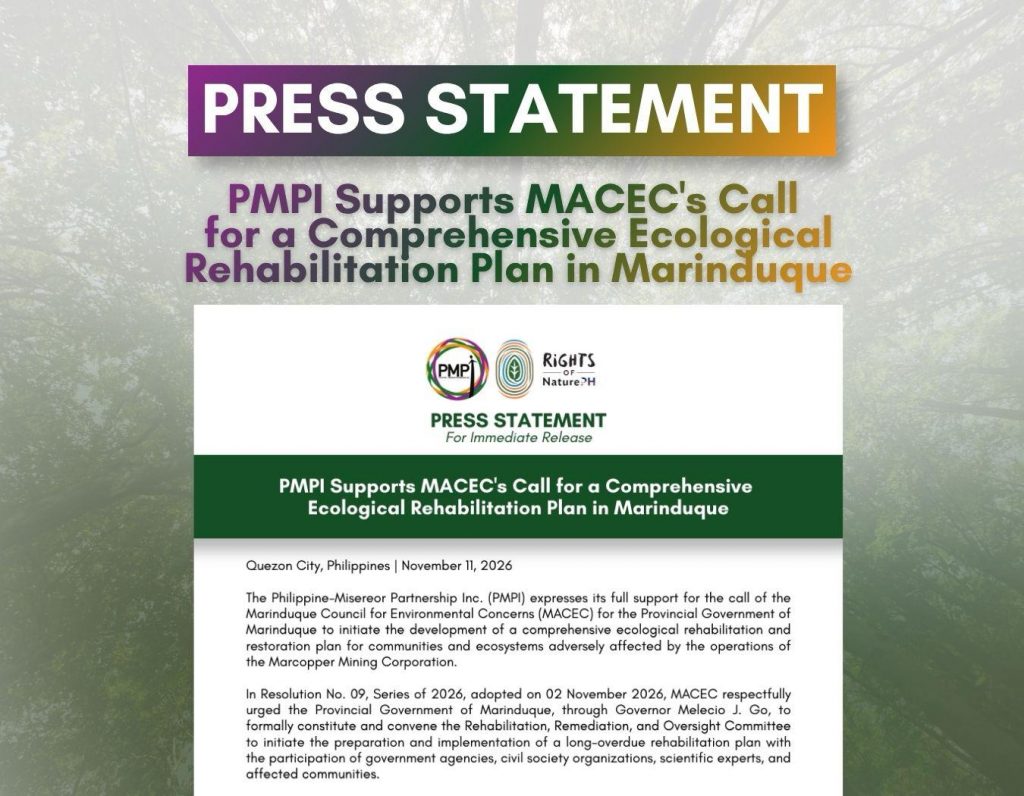
Quezon City, Philippines – The Philippine-Misereor Partnership Inc. (PMPI) expresses its full support for the call of the Marinduque Council for Environmental Concerns (MACEC) for the Provincial Government of Marinduque to initiate the development of a comprehensive ecological rehabilitation and restoration plan for communities and ecosystems adversely affected by the operations of the Marcopper Mining Corporation.
In Resolution No. 09, Series of 2026, adopted on 02 November 2026, MACEC respectfully urged the Provincial Government of Marinduque, through Governor Melecio J. Go, to formally constitute and convene the Rehabilitation, Remediation, and Oversight Committee to initiate the preparation and implementation of a long-overdue rehabilitation plan with the participation of government agencies, civil society organizations, scientific experts, and affected communities.
This call reflects a continuing and urgent concern not only for the people of Marinduque but also for the rivers, coastal ecosystems, forests, and other natural systems that continue to bear the consequences of decades of mining-related degradation. The Boac and Mogpog River systems, Calancan Bay, and surrounding ecosystems remain impaired by mining operations and tailings disposal, resulting in long-term ecological, social, cultural, and economic harm. These ecosystems require sustained restoration efforts to recover their ecological integrity, vitality, and capacity to sustain life.
PMPI joins MACEC in urging the Provincial Government of Marinduque to move forward with this long-overdue rehabilitation process, particularly now that resources are available to initiate meaningful action. Concerns over administrative or legal expenditure should not obstruct efforts to address decades of environmental damage and ecological injustice. We likewise support MACEC’s call to immediately convene the Rehabilitation, Remediation, and Oversight Committee to provide transparent, accountable, science-based, and participatory governance of the rehabilitation process.
The scale and complexity of ecological restoration in Marinduque demand a multi-stakeholder oversight mechanism that ensures thorough scientific assessment, public accountability, and meaningful participation of affected communities. Such a body can help establish priorities, monitor progress, and uphold transparency throughout the rehabilitation process.
“The voices of affected communities must be at the heart of rehabilitation efforts. Forming a Multi-Stakeholder Oversight Group should be one of the first steps toward ensuring that rehabilitation is grounded in the lived realities, knowledge, and aspirations of local people,” PMPI National Coordinator Yolanda Esguerra stressed. “Those who have directly experienced the consequences of ecological destruction are uniquely positioned to serve as guardians and advocates for both their communities and the ecosystems upon which they depend,” Ms. Esguerra further emphasized.
Rehabilitation is not solely about compensating human losses or rebuilding damaged infrastructure. It is also about recognizing the right of rivers, forests, coastal ecosystems, and other natural communities to recover, regenerate, and flourish. Ecological restoration is therefore both a social responsibility and a form of restorative justice for nature itself.
The well-being of Marinduque’s communities is inseparable from the health of its ecosystems. Human health, livelihoods, food security, culture, and resilience depend upon thriving rivers, productive coastal waters, healthy forests, and functioning ecological processes. Restoring nature is therefore not separate from restoring community well-being; the two are fundamentally interconnected.
We call on the Provincial Government of Marinduque to listen to the voices of both the people and the natural systems that sustain the island. The continued delay of rehabilitation prolongs ecological harm and undermines the prospects for a just and sustainable future.
The time has come to advance ecological restoration, accountability, and regenerative development that honors the rights of nature while securing the well-being of present and future generations of Marinduqueños. Rehabilitation should not be about repairing past damage. It is about restoring relationships among people, nature, and ensuring that both communities and ecosystems can heal, thrive, and flourish together.
Philippine Misereor Partnership Inc.
For inquiries, you may email secretariat@pmpi.org.ph or rightsofnaturecampaign@gmail.com
PMPI, Quezon Avenue, Unit 204 Pacific Century Tower 1472-1476, Brgy. South Triangle, 1103, Quezon City